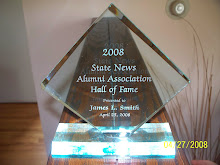
The first of a five-part series on journalism in the Detroit Metropolitan Area appeared Thursday in a Crain's publication or section called "Detroit Make It Here."
I was interviewed back in April for this series, but don't know if, or when, my comments will appear. It looks like the series is scheduled for every Thursday for the next 4-5 weeks.
Showing posts with label journalism. Show all posts
Showing posts with label journalism. Show all posts
Friday, June 26, 2009


Saturday, June 13, 2009
A reporter chimes in on the topic of the year
A Kansas City Tribune reporter chimes in on newspaper standards. It's a good read, except for the slightly gratuitous bone she throws to her own employer at the end.
My favorite paragraph:
"Today, corporate owners of newspapers have turned our newsrooms into little more than sweat shops. While we lofty public servants, otherwise known as working journalists, agonize over the facts and minute details in each piece we prepare for print, corporate has another goal. It seems the companies that make it their business to own daily newspaper chains are obsessed with trying to squeeze more profit from those who, like me, entered the profession believing we are providing our readers with the truth about the conduct of the public’s business."
Monday, June 8, 2009
An 'old timer's' lament
This is a great read by a reporter who I remember reading. She has captured perfectly the demise of newspapers. It's a long tome (well worth the time), but here are three of my favorite parts:
"Page redesign – that harbinger of newspaper death -- had already hit The Record. Seeking answers elsewhere, the business managers bought in to another notion of what could save the day: "CI," short for "Continuous Improvement." Some called it "Constant Insanity." It was a business improvement model, inspired by the Japanese, meant to impose greater order and efficiency on the daily newspaper."
And then this that could have been written about the ninnies who prowled the Flint Journal newsroom during the last several years:
"Our percentage of days meeting deadlines was supposed to improve, our general wastefulness decline. Signs went up around the newsroom, with the word "Muda," or mess, in Japanese and the international interdiction sign across it. We received threats and reprimands about the pileup of papers on our desks. Had my fourth-grade teacher, Miss Dade, been reincarnated as a Twenty-first Century newspaper editor? It was hard to know whether this was a misguided business department mandate or one person's obsessive-compulsive disorder. Either way, it was an unconscious metaphor. By definition, journalism was creative and untidy and all of the efforts to treat it like banking or insurance or accounting misunderstood its essential nature – and would be sure to fail.
Panic seemed to intensify at the Record, in the form of quantification. How large is the mess on your desk? How many minutes late is your copy? How many words are in your lead? There should be no more than 26, it was rumored. There were edicts against anecdotal leads, and leads with dependent clauses. Annual reviews included byline counts – how many stories could you write in how short a time?"
And this is rich also:
"Still, many editors were driven by an opposing motive to win journalism prizes. Bad ideas floated downward from sterile news meetings where editors tried to second-guess an imagined Pulitzer board. Or they recycled old ideas that had already won prizes. Police brutality was a favorite. Nursing home abuses. Kids who kill. These were often more topics than stories. Let's write a 10-part series on PCP – so we did. But the winning-prizes motive could occasionally leave room for serendipity, for real, original creations to emerge from the notebooks of reporters who were out in the world. There was still hope for the languid."
Candy Cooper nailed it. Wish I'd written it.
Northwestern computer nerds to the rescue?
A hybrid journalist/computer nerd is the newest graduate type out of Northwestern University. A great journalism school, by the way. Not quite as good as Michigan State University, but close. This came from Fading to Black.
A look at the disappointing Chicago meeting of newspaper types
Another Facebook find. A story by John Temple, former Rocky Mountain News guy.
Forbes.com: The future of journalism
Found this article about the "shoot-out" over news gathering in San Diego. Thanks to a Facebook friend who posted this there this morning.
Sunday, June 7, 2009
A little bit of optimism for those left behind
For the folks still laboring in the trenches at newspapers comes this bit of optimism from Fading to Black.
And I will admit, that for me, there is no excitement and satisfaction as fulfilling as that when I found a juicy or unusual story that I could not wait to investigate and tell.
I get the attraction.
And I will admit, that for me, there is no excitement and satisfaction as fulfilling as that when I found a juicy or unusual story that I could not wait to investigate and tell.
I get the attraction.
Tuesday, June 2, 2009
One more newspaper article for today
This from Fading to Black about newspapers which are still making money.
Two articles worth the read
Thankfully, this blog, which gets an average of 480 hits per day (about 20 percent of them new visitors) has very informed readers who often send along links to really good stories about journalism and newspapers.
Here is one of the best summaries I have read so far.
Just a small excerpt, but the rest is worth reading as well:
"When you hear a newspaper executive claiming that his industry is an essential bulwark of society and that it stands threatened by a new technology that is, as of yet, unready to shoulder the same responsibility, you may be inclined to empathize. And indeed, that much is true enough as it goes.
But when that same newspaper executive then goes on to claim that this predicament has occurred through no fault on the industry's part, that they have merely been undone by new technologies, feel free to kick out his teeth. At that point, he's as fraudulent as the most self-aggrandized blogger."
Here's another from the Huffington Post.
Thanks to the two readers who supplied the links.
Sunday, May 10, 2009
Frank Rich checks in on the future of journalism
If you're not a member of the New York Times, you may have to take a minute to register to get this article about the current state of journalism.
Friday, May 8, 2009
A working newspaper model
An opinion piece by the Christian Science Monitor on the many newspapers who continue to make money using the old model.
Wednesday, May 6, 2009
Fired by phone, while on a sports assignment
I was fired once. Not because I had done anything wrong, but because the weekly I worked for at the time was sold out from under me.
I hung around for a couple weeks, but realized I could never work for the new owners and one day a pathetic lady showed up at my office and told me to publish something in the newspaper that was so far beneath what a newspaper should do that I refused.
The lady told me if I didn't publish it, I would likely be fired. Well, she was right. I didn't print it and I was fired. But at least she was "man" enough to do it in person. No hard feelings.
But look what happened to this sports reporter.
I also knew another newspaper employee who was once fired in the middle of the Arizona desert via cellphone while he was on an assignment.

Tuesday, May 5, 2009
President Obama to newspapers: Drop dead!
OK, that may be a little over the top, but I will never forget the New York headline about another President's failure to bail out a whole city.
Anyway, here's the brief give and take about newspapers at a White House press conference.
By the way, I agree that the government should not bail out newspapers, or any other media for that matter.
Anyway, here's the brief give and take about newspapers at a White House press conference.
By the way, I agree that the government should not bail out newspapers, or any other media for that matter.
Monday, April 27, 2009
What to do with that buyout: Start a competing website
A poster provided this link to an Editor and Publisher article about an online news service started by some Star-Ledger refugees.
A few of my buyout buddies will attest that there was some preliminary attempts to do a Flint online news service made up of Journal refugees, but none of use could figure out how it could make money.
Unless, like the Star-Ledger folks, you are willing to work for free starting up another website is not a profitable venture, at least at this point.
NY Times: The new journalism school curriculum
A reader sent this link to a NY Times piece about what journalism schools are teaching now that the old model is quickly fading.
Newsosaur offers another perspective: Raise the single copy price
Not sure I agree completely with this idea floated by Reflections of a Newsosaur, but it's worth a read.
Sunday, April 26, 2009
A sad story about the Sun-Times Media Group
Found this on Facebook. It's a story of the last day of the reporters at the Sun-Times media group.
Thursday, April 23, 2009
Another Titanic reference for a newspaper.
Newspaper Death Watch has linked to a mock front page apparently put together by employees at a McClatchy paper unhappy with their boss.
Wednesday, April 22, 2009
Blogger: A future for journalism, but not newspapers
My stepdaughter found this long, but interesting article on the future of newspapers versus the future of journalism.
I didn't take the time to read the comments, but there are 888 of them as of today.
I didn't take the time to read the comments, but there are 888 of them as of today.
Subscribe to:
Posts (Atom)